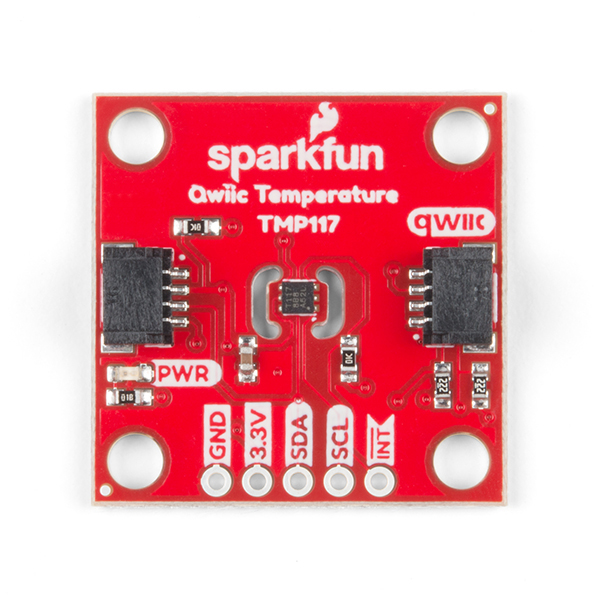
SparkFun High Precision Temperature Sensor – TMP117 (Qwiic) | Amtronics
SparkFun High Precision Temperature Sensor – TMP117 (Qwiic)
SparkFun High Precision Temperature Sensor – TMP117 (Qwiic)See More
Out of Stock
8.500 KD
1
Total: 8.500 KD
Quality guarantee
14-day return policy
Product Description
The SparkFun Qwiic TMP117 breakout is a high precision temperature sensor equipped with an I2C interface. It outputs temperature readings with high precision of ±0.1°C across the temperature range of -20°C to +50°Cs with no calibration and a maximum range from -55°C to 150°C. The SparkFun High Precision Temperature Sensor also has a very low power consumption rate which minimizes the impact of self-heating on measurement accuracy. Utilizing our handy Qwiic system, no soldering is required to connect it to the rest of your system. However, we still have broken out 0.1″-spaced pins in case you prefer to use a breadboard.
The SparkFun High Precision Temperature Sensor also includes programmable temperature limits, and digital offset for system correction. While the TMP102 is capable of reading temperatures to a resolution of 0.0625°C and is accurate up to 0.5°C, the on-board TMP117 is not only more precise but has a 16-bit resolution of 0.0078°C!
To make this breakout even easier to use, we’ve written an Arduino library to help you get started “Qwiic-ly.” Check the Documents tab above for more information.
Uses I2C interface (Qwiic-enabled)
Four selectable addresses
0x48 (default), 0x49, 0x4A, 0x4B
16-bit resolution, 0.0078°C
High accuracy, digital temperature sensor
±0.1°C (max) from –20°C to 50°C
±0.15°C (max) from –40°C to 70°C
±0.2°C (max) from –40°C to 100°C
±0.25°C (max) from –55°C to 125°C
±0.3°C (max) from –55°C to 150°C
Operating temperature range
-55°C to +150°C
Operating voltage range
1.8V to 5.5V
Typically 3.3V if using the Qwiic cable
Low power consumption
3.5µA (1-Hz conversion cycle)
150nA (shutdown current)
Programmable operating modes
Continuous, one-shot, and shutdown
Programmable temperature alert limits
Selectable averaging for reduced noise
Digital offset for system correction
NIST traceability